Regular employee training in information security and internal policies is an important part of how an organization operates. But training alone is not enough. We also need to continuously verify that employees truly understand the rules and are able to apply them in practice.
At Sykora IT, we manage this process using Atlassian Rovo. Instead of relying on a single static test that needs to be prepared manually and updated whenever a policy changes, we use Rovo to create an interactive way of verifying employees’ knowledge.

Why Do We Use Rovo for Testing?
As part of our projects, we need to regularly verify the training of both internal and external employees, for example in the areas of information security and internal policies.
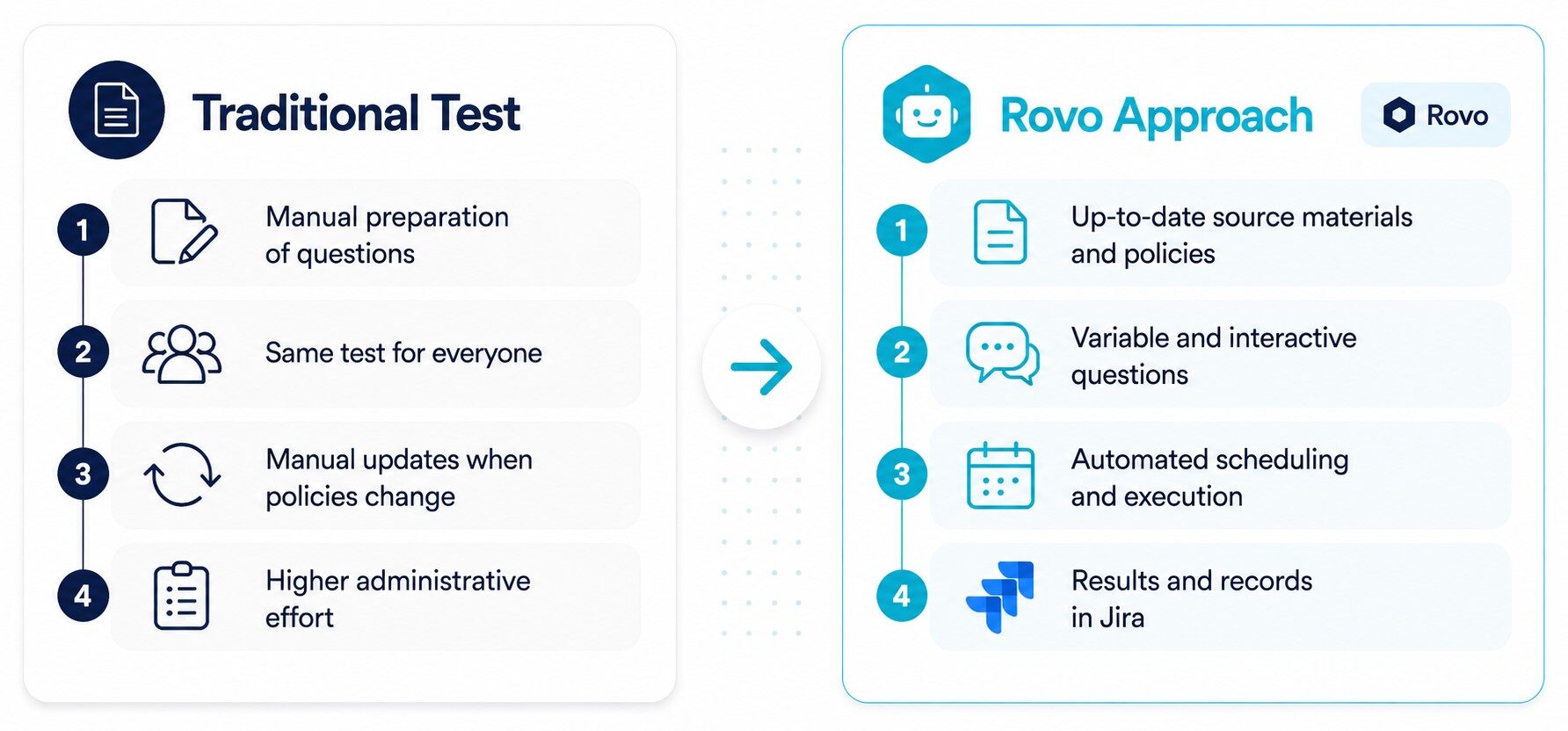
The traditional approach usually involves preparing a set of questions, setting up a test, and then regularly reviewing and updating it. However, as soon as an internal policy or another source document changes, additional administrative work is required. The questions need to be reviewed, their accuracy verified, and the test updated where necessary.
We also did not want employees to complete the same test with the same questions every year.
That is why we looked for a way to automate a larger part of the process while still maintaining control over the source materials the test is based on.
Rovo as the Foundation for Interactive Testing
For this purpose, we created a solution based on a Rovo agent that works with defined company source materials.
Instead of completing a predefined form with a fixed set of questions, employees go through an interactive testing process. The questions can be generated based on the current content of relevant policies and other documents.
As a result, each test can be slightly different while still being based on the same organizational requirements.
In this scenario, Rovo provides us with several benefits:
Testing based on up-to-date source materials – when a policy changes, there is no need to manually rewrite the test or remember to update it.
Interactive testing – employees interact directly with the agent instead of filling in the same form repeatedly.
Variable questions – individual tests can contain different sets of questions.
Multilingual support – the same scenario can be used for employees communicating in different languages, as the agent adapts to the user’s language.
Automation of the entire process – testing can be connected with other Atlassian tools and triggered according to predefined rules.
Automating Testing in the Atlassian Environment
The Rovo agent itself is only one part of the solution. Jira Automation also plays an important role, allowing us to manage the entire process.
Testing can, for example, be scheduled automatically at regular intervals or triggered for a specific group of employees. Corresponding tasks are created for individual users, who then complete the test through Rovo.
Once the test is completed, the result can be automatically recorded directly in the relevant Jira ticket. This gives the organization an overview of who has completed the test and with what result.
There is therefore no need to create a separate process outside the tools already in use. Testing, automation, and result tracking can all remain within the Atlassian ecosystem.
Easier Test Management
One of the main reasons we chose this approach is the time saved in preparing and maintaining tests.
With a static test, someone needs to regularly review not only the policies themselves but also all related questions. With Rovo, much of this work is handled by the agent, which works directly with the current source materials.
The role of the responsible person, such as the CISO or the owner of a particular policy, therefore changes. Instead of repeatedly preparing test questions, they can focus primarily on checking that the agent has the correct source materials and that the overall process works as expected.
Automation also reduces other routine tasks, from creating and assigning testing tasks to recording the results.
Rovo as a Practical Use of AI in Atlassian
This use case demonstrates that Rovo does not have to be used only for searching for information or answering questions based on company documentation.
When combined with Jira, Confluence, and automation, it can become part of a specific business process in which AI works with internal knowledge while also integrating with the organization’s existing workflows.
For us, employee training and testing is one example where this type of integration delivers practical value: it reduces manual work, makes it possible to continuously work with up-to-date source materials, and at the same time maintains the required level of evidence and control over the entire process.
Do you have a similar use case, or are you looking for ways to use Rovo in your own organization? Get in touch with us. We’ll be happy to discuss the possibilities and propose a solution tailored to your environment.