
Manufacturing companies today operate in increasingly complex environments. Product development is no longerf a linear process. It requires close collaboration between hardware and software teams, production, and business functions such as sales and marketing.
At the same time, many organizations still rely on a mix of disconnected tools. Spreadsheets are used for planning, emails for communication, and separate systems for documentation and development. While these tools may work individually, they often fail to provide a consistent and up-to-date view of projects as a whole.
Platforms like Jira and Confluence, together with emerging AI capabilities such as Atlassian Rovo, are helping manufacturing companies address this challenge by connecting work, knowledge, and teams.
Connecting teams across the organization
One of the main challenges in manufacturing environments is aligning different teams with different ways of working.
Hardware development often follows structured phases. Software teams typically work iteratively. Production requires stable and well-defined inputs. Business teams depend on accurate and timely information.
Without a shared system, coordination becomes difficult.
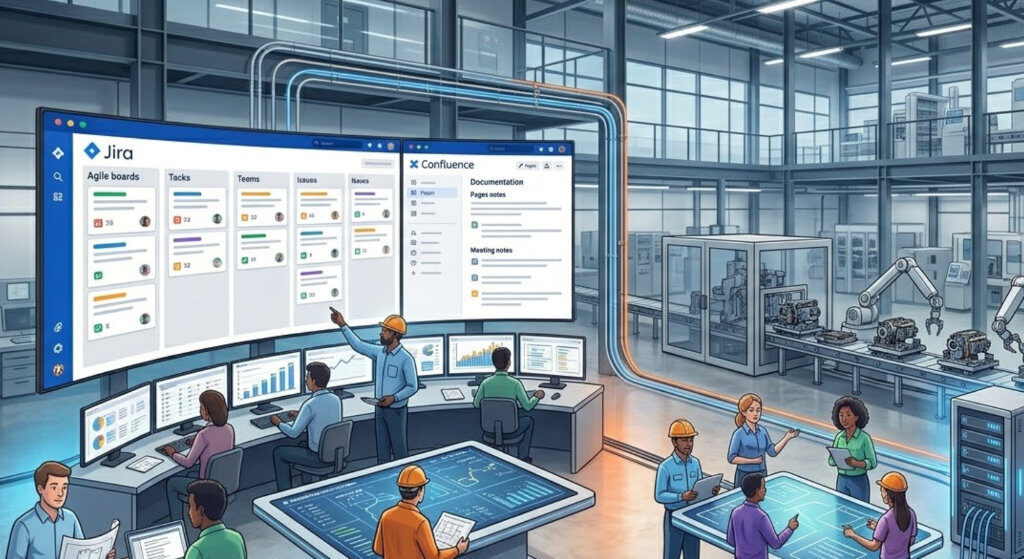
Jira provides a central place where all work can be managed. Tasks, responsibilities, and deadlines are clearly defined. Dependencies between teams are visible. Progress can be tracked in real time.
Confluence complements this by providing a shared space for documentation. Product specifications, test results, decisions, and production guidelines can all be stored in a structured and accessible way.
Together, these tools ensure that teams are working with the same information, reducing misunderstandings and improving alignment.
Supporting the full product lifecycle
Manufacturing projects typically move through multiple phases, from initial concept and prototyping to testing and serial production.
Jira allows organizations to structure these phases and break them down into manageable work items. This makes it easier to understand the current state of a project, coordinate transitions between phases, and track progress across teams.
Confluence links documentation directly to these phases, ensuring that knowledge is captured and remains accessible over time. This is especially valuable in environments where decisions made early in the project can have long-term impact.
Moving beyond static planning
Planning in many manufacturing companies is still based on spreadsheets. While familiar and flexible, these tools quickly become outdated and difficult to maintain.
When planning is moved into Jira, updates are reflected immediately and changes can be managed continuously. Dependencies between tasks can be adjusted dynamically, and teams can respond more effectively to changing requirements.
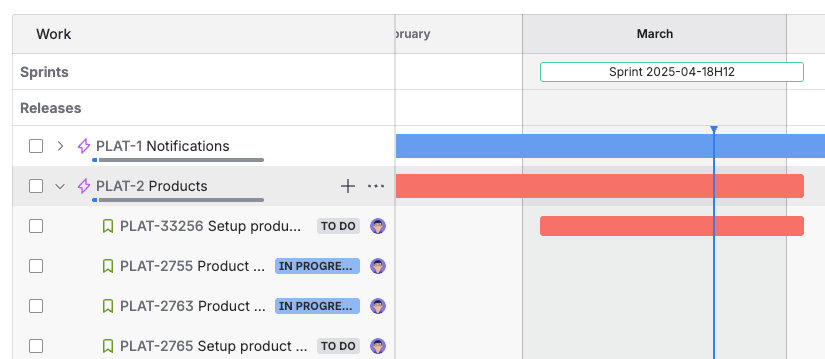
Time tracking can also be integrated into daily work. This allows organizations to compare planned and actual effort, generate reports more easily, and reduce manual administrative work.
The result is a more accurate and transparent view of project progress.
Automating routine work
Modern collaboration tools also make it possible to automate repetitive tasks.
In Jira and Confluence, organizations can define rules that automate task transitions, notifications, and validations. Reports and summaries can be generated automatically, reducing manual effort and ensuring consistency.
Automation helps standardize processes across teams while allowing people to focus on more valuable activities.
Improving access to knowledge with AI
As projects grow in size and complexity, accessing the right information becomes more difficult. Knowledge is often distributed across systems, documents, and teams.
AI-powered solutions such as Atlassian Rovo improve how users interact with this information.
Rovo enables unified search across tools like Jira and Confluence. It can provide context-aware answers based on project data and documentation, generate summaries of tasks or updates, and help users quickly find what they need.
For manufacturing companies, this means less time spent searching for information and more time spent using it.
A practical approach to adoption
Adopting these tools does not require a complete transformation from the start. Many organizations benefit from a gradual approach.
A typical path includes starting with a pilot project, defining a simple structure, involving key users early, and expanding step by step. Automation and AI capabilities can be introduced once the core system is in place.
This approach minimizes risk and ensures that the solution evolves based on real usage.
Conclusion
Jira, Confluence, and AI-powered tools like Rovo provide a strong foundation for improving collaboration in manufacturing environments.
By connecting work management, documentation, and knowledge access, organizations can improve coordination across teams, increase transparency, reduce manual effort, and make better use of their data.
In a context where projects are becoming more complex and interdependent, these capabilities are increasingly important for maintaining efficiency and scalability.


Manage Azure Assets in Jira Cloud Webinar
How to manage Assets in Jira Join us for a practical webinar on building an effective Cloud Asset Management platform in Jira Service Management Cloud using our app Azure Sync for Jira Assets. See how Rovo Agents can improve the process. Request for recording After filling out the form, we will
How Jira, Confluence, and AI Are Transforming Collaboration in Manufacturing Companies
Manufacturing companies today operate in increasingly complex environments. Product development is no longerf a linear process. It requires close collaboration between hardware and software teams, production, and business functions such as sales and marketing. At the same time, many organizations still rely on a mix of disconnected tools. Spreadsheets are used for
Atlassian Cost Optimization Review
Atlassian Cost Optimization Review: Optimize licenses, apps and usage before unnecessary costs add up Are you fully in control of your Atlassian spending? As Atlassian environments grow, cost management is becoming more complex. It is no longer only about the number of licensed users or Marketplace apps. With Atlassian expanding